Don t Be All Hat and No Cowboy Svg Desig
When I am reviewing an embroidery file for a client or my own small shop, I am looking for more than just a cute phrase. I am looking for structural integrity, visual balance, and marketability. The design in question today, titled Don t Be All Hat and No Cowboy Svg Desig, falls squarely into the Crafts and Graphics categories, but its true value lies in how it translates from a digital vector to a stitched textile. As a designer who has spent years troubleshooting dense stitch areas and color clashes, I want to break down whether this design is ready for your hoop or if it needs some serious pre-production adjustments.
First Impressions and Visual Personality
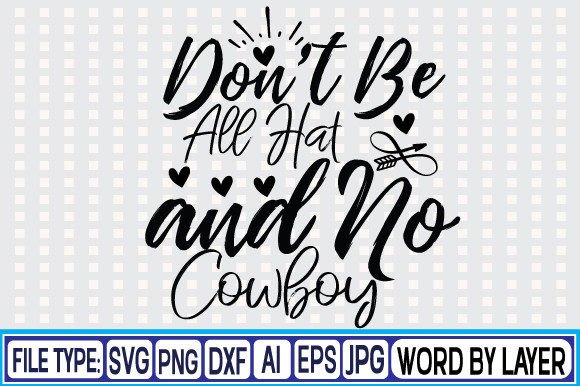
The moment you load the source files, which include both Adobe Illustrator (.Ai) and SVG formats, the layout of Don t Be All Hat and No Cowboy Svg Desig reveals a playful, slightly rustic personality. The typography is bold, suggesting that legibility is a primary concern for the original creator. For embroidery, this is crucial. Thin, delicate scripts often get lost in the fabric or become difficult to digitize without excessive thread breaks. Here, the lettering feels substantial, promising a finished product that reads clearly even from a distance.
The theme itself—playing on the idiom about being all hat and no cowboy—suggests a Western, country, or humorous vibe. This immediately tells me where this design belongs: not in a minimalist nursery, but likely in a casual, fun setting. It creates a mood of approachable humor. When I look at the shape and negative space, I see potential for strong contrast against textured fabrics like denim or heavy cotton canvas. However, the "Svg" nature of the title reminds us that we are starting with a graphic asset. Before any stitching happens, we must evaluate how those sharp vector lines will behave when converted into satin stitches or fill stitches by our digitizing software.
Real-World Application: The Custom Tote Bag Scenario
To truly understand the utility of this design, let’s imagine a real project. You are preparing inventory for an upcoming craft fair or updating your Etsy listings. You decide to create a custom embroidered tote bag for a boutique client. You choose a sturdy, natural-colored canvas tote. You place Don t Be All Hat and No Cowboy Svg Desig centrally on the front panel.
In this scenario, the design performs well because of its horizontal balance. A tote bag offers a large, flat surface area, allowing the text to breathe. If you use a high-contrast thread color, such as deep navy or black on the natural canvas, the message pops. Customers walking through a craft fair stall can read the joke instantly. This immediate recognition boosts engagement. It is not just a bag; it is a conversation starter. For an Etsy seller or small business owner, designs that evoke an emotional reaction or a chuckle tend to convert better than generic floral patterns. This design taps into that psychological trigger effectively.
However, consider the back of the bag. If you were to add a smaller embroidered patch or logo there, does this design clash? Probably not. Its standalone strength means it works well as a focal point rather than a background element. It commands attention, which is exactly what you want for a hero product in your craft business.
Performance Across Different Product Types
While the tote bag is an obvious fit, Don t Be All Hat and No Cowboy Svg Desig has versatility that extends to other custom apparel items. Let’s look at a few specific applications:
- Sweatshirt Embroidery: On a crewneck sweatshirt, this design adds a touch of personality to a cozy staple. The weight of the garment supports heavier thread densities, so you don’t need to worry about the fabric puckering too much, provided you use a proper cut-away stabilizer.
- Embroidered Patch: Converting this into a detachable patch is a smart move for commercial embroidery projects. Patches allow customers to apply the design to various items, increasing the perceived value of the product. The bold lines translate beautifully to applique designs, where the base fabric forms the letters and a contrasting top layer provides definition.
- Holiday Embryery: While not strictly holiday-themed, the humorous tone fits well with gift-giving seasons. A personalized gift featuring this design appeals to adults who appreciate wit, making it a strong candidate for personalized gifts for fathers, grandfathers, or friends with a love for western culture.
- Kitchen Towels and Aprons: For the home cook with a sense of humor, this design on a kitchen towel or apron adds charm. The frequent washing required for these items means durability is key. The design’s simple structure reduces the risk of thread tangling during wash cycles compared to overly complex pictorial designs.
Where to Use Caution: Technical Limitations
No design is perfect for every situation. As an experienced reviewer, I must highlight where Don t Be All Hat and No Cowboy Svg Desig might struggle. First, avoid using this on curved surfaces like baseball caps unless you have advanced digitizing skills. The straight lines of the text may distort awkwardly around the curve of a cap front, especially if the hoop size is small and forces significant compression.
Second, be wary of using this on stretchy knits without adequate stabilization. If the fabric stretches under the tension of the machine needle, the text could warp. Always test on scrap fabric first. Third, if you plan to embroider this on dark fabric, ensure your thread colors provide enough contrast. A light grey thread on a black shirt will disappear, ruining the visual appeal and making the finished product look cheap.
Additionally, check the small details. If the original SVG includes tiny decorative elements or thin serifs, these may not survive the stitching process. They might break or merge with adjacent threads. In such cases, simplifying the design in your editing software before digitizing is essential. Remember, less is often more in machine embroidery.
Practical Designer Notes for Success
To ensure your final product looks professional and sells well, follow these practical steps:
- Test Stitch Density: Review the stitch density in your digitizing software. If the design is too dense, it will feel stiff and uncomfortable. If it is too sparse, the fabric backing may show through. Adjust accordingly.
- Check Thread Colors: Compare your chosen thread colors against your fabric swatches. Use a black-and-white filter in your design software to check contrast levels. High contrast ensures readability.
- Use Proper Stabilizer: Never skip the stabilizer. For woven fabrics like cotton or linen, a tear-away stabilizer is usually sufficient. For knits or stretchy materials, a cut-away stabilizer is necessary to maintain shape over time.
- Confirm Licensing: Before selling finished items, double-check the licensing terms associated with the digital download. Ensure you have commercial rights to sell physical products made from this design. This protects your brand consistency and legal standing.
- Create Printable Mockups: Before committing to production, create printable mockups to visualize the design on different products. This helps you market the item effectively on social media and your online store.
Final Verdict
Don t Be All Hat and No Cowboy Svg Desig is a solid choice for designers and sellers looking to add a touch of humor and personality to their inventory. It is versatile enough for tote bags, sweatshirts, and aprons, and its bold typography ensures it stands out in a crowded marketplace. By paying attention to technical details like stitch density, fabric choice, and stabilization, you can transform this digital asset into a high-quality handmade product that customers will love. Just remember to test thoroughly and respect the limitations of the medium. With careful execution, this design can be a reliable workhorse in your embroidery project library.